Learning Surfing-like Balance without Water Simulation
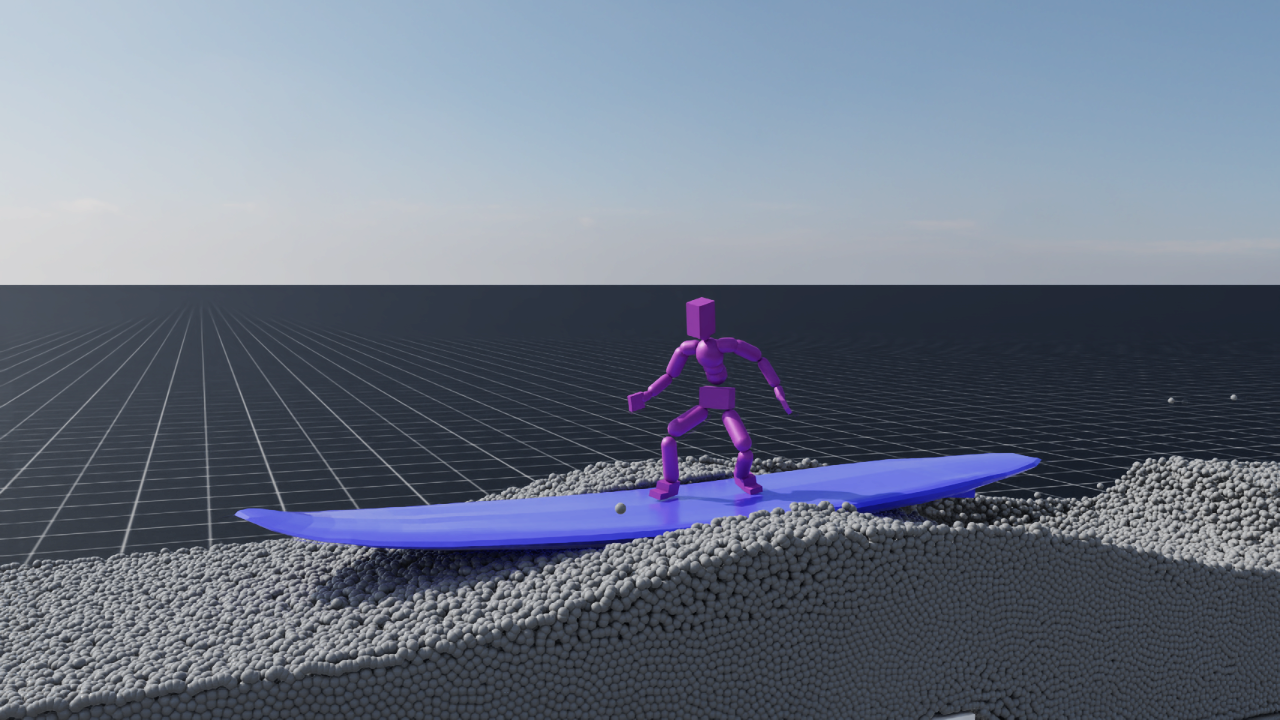
Our method learns surfing-like balance control without water simulation. The learned policy maintains stable balance on a moving board under wave conditions at runtime.
Video
Abstract
Controlling characters in fluid environments such as water remains challenging due to complex dynamics and high simulation cost. In particular, surfing requires maintaining balance on a continuously moving support, making stable control difficult without accurate physical modeling. In this work, we present a method for learning surfing-like balance control without relying on water simulation. Our approach combines a hierarchical control framework with a stage-based training scheme that progressively introduces dynamic board behavior. The low-level policy generates full-body motion from partial joint targets, while the high-level policy adapts these targets based on environmental conditions. Despite being trained entirely in a non-fluid setting, the learned policy maintains stable balance on a moving board under wave conditions at runtime. These results suggest that surfing-like balance can be achieved without explicitly modeling fluid dynamics through appropriate control structures and training strategies.
Method Overview
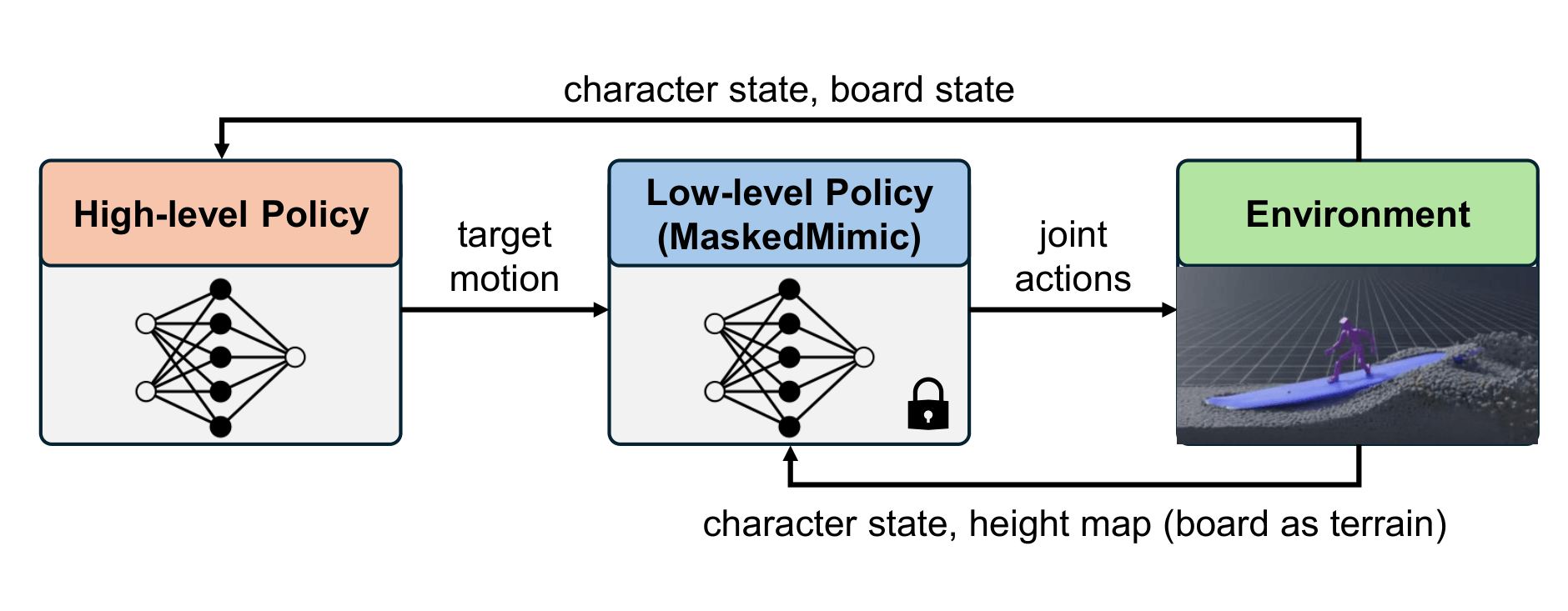 Our framework is composed of a low-level policy and a high-level policy. The low-level policy is a pretrained MaskedMimic model that tracks target motions defined on six key joints (root, head, hands, feet) to produce full-body motion, without requiring task-specific reference motions. The high-level policy observes the character and board states and predicts residual offsets on top of a predefined surfing pose, adapting the tracked targets to the board’s movement. This separation lets the low-level policy focus on stable full-body motion while the high-level policy handles adaptation to the dynamic environment.
Training Objective
The high-level policy is trained with the following reward:
r = w1rboard + w2rcontact + w3rstability + w4rfoot + w5rhead + w6rsmooth
combining terms for board stability, foot contact/slipping, foot placement, head orientation, and motion smoothness. To avoid relying on water simulation, we introduce dynamic board behavior gradually through a stage-based curriculum: Stage 1 trains balance on a board suspended in the air with only pitch stabilized, exposing the policy to lateral (roll) instability; Stage 2 adds forward motion and a gradually increasing target pitch, producing coupled translational and rotational dynamics that resemble surfing. Under forward motion and time-varying board pitch, adding Stage 2 raises the success rate from 15% to 60% over Stage-1-only training, and despite never being trained in water, the resulting policy also generalizes to maintain balance under wave conditions at runtime.